
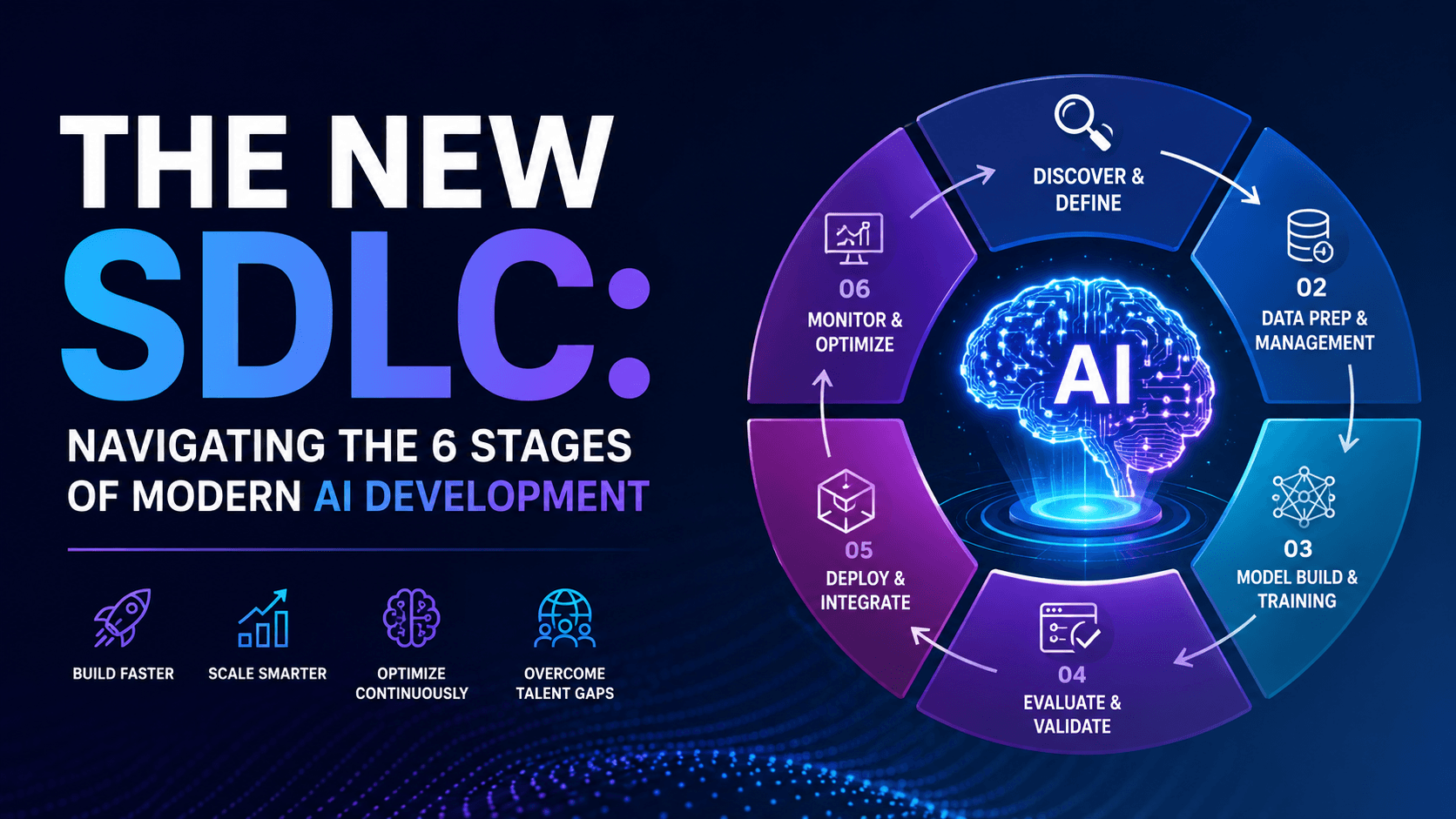
The New SDLC: Navigating the 6 Stages of Modern AI Development
The traditional Software Development Life Cycle (SDLC) is dead. For CTOs and Founders in 2026, the waterfall and even standard Agile methodologies are insufficient when the core of your product is a non-deterministic AI model.
The "move fast and break things" mantra has evolved into "scale fast and optimize constantly." However, most companies are hitting a massive bottleneck: a 3-6 month hiring cycle for local talent that costs $200k+ per head. While you wait for a local Senior ML Engineer to sign an offer letter, your competitors have already shipped three iterations of their LLM-integrated platform.
To stay competitive, you must understand the modern AI development stages and how to bypass the talent shortage.
1. Problem Definition & Feasibility Analysis
In AI development, the first stage isn't coding; it’s mathematical and ethical validation. Unlike traditional SaaS, where you know a feature can be built, AI requires assessing if the data supports the desired outcome.
- The Objective: Define the KPI (e.g., reducing churn by 15% or automating 80% of support tickets).
- The Challenge: Determining if you need a Fine-Tuned Model, a RAG (Retrieval-Augmented Generation) architecture, or a simple API wrapper.
- The Resource Trap: Local PMs often spend months in "discovery" because they lack the technical depth to vet AI feasibility quickly.
2. Data Engineering: The New "Frontier"
Data is the fuel of AI, but raw data is usually "dirty." This stage consumes nearly 60% of the development timeline.
- Ingestion & Cleaning: Moving data from legacy silos into a centralized vector database.
- Labeling & Annotation: Ensuring the ground truth is accurate.
- Privacy Compliance: Stripping PII (Personally Identifiable Information) to meet GDPR and CCPA standards before the data touches a model.
3. Model Selection & Architecture Design
In 2026, you aren't just choosing between "Build vs. Buy." You are choosing between Open-Weight vs. Closed-Source.
- Proprietary APIs: Fast to market, but high long-term OpEx and zero IP ownership.
- Open-Weight (Llama 4, Mistral): Requires significant infrastructure but offers full control over data privacy and long-term cost efficiency.
- Architecture: Setting up the orchestration layer (using tools like LangChain or n8n) to connect the AI to your existing business logic.
4. Training, Fine-Tuning, and RAG Implementation
This is where the "intelligence" is tailored to your specific business.
- RAG (Retrieval-Augmented Generation): Connecting your model to your live knowledge base so it doesn't hallucinate.
- Fine-Tuning: Adjusting the model's weights on your specific dataset to mirror your brand voice or industry-specific jargon.
- Optimization: Implementing techniques like TurboQuant or 4-bit quantization to ensure the model runs efficiently on hardware like the RTX 4060 Ti or specialized server-side GPUs without skyrocketing your cloud bill.
5. Evaluation & Red Teaming
Traditional QA cannot test AI. You need LLM-as-a-Judge and rigorous Red Teaming.
- Automated Benchmarking: Running the model against thousands of "Golden Sets" to ensure accuracy.
- Safety Testing: Ensuring the AI doesn't leak sensitive data or generate biased outputs.
- Latency Testing: Ensuring the response time meets the expectations of a modern B2B user.
6. Deployment & LLMOps
The final stage is moving from a Jupyter Notebook to a production-grade environment. This involves containerization (Docker/Kubernetes) and continuous monitoring. AI models drift over time; their performance degrades as world data changes. LLMOps ensures your AI stays as sharp on Day 300 as it was on Day 1.
The Strategic Bottleneck: Why Your Local Hiring is Failing
The primary reason AI projects fail in the US and EU isn't the technology—it's the Hiring Lag.
| Feature | Local In-House Hiring | Jalsonic IT Outsourcing |
|---|---|---|
| Hiring Timeline | 3 - 6 Months | 2 - 4 Weeks |
| Total Cost (SDR) | $180k - $250k + Benefits | $60k - $90k (All-inclusive) |
| Tech Stack Expertise | Limited to available local pool | Global access to niche AI/ML experts |
| Scalability | Rigid (Hard to hire, harder to fire) | Elastic (Scale up/down per sprint) |
| Focus | Management & Admin heavy | Pure delivery & Output focused |
Moving from "Hiring" to "Shipping"
For a Founder or CTO, every day your AI feature is not in production is a day of lost market share. The 3-6 month window you spend interviewing candidates is the same window your competitor uses to capture your lead base.
By leveraging a specialized IT outsourcing partner, you bypass the geographical tax on talent. You gain access to engineers who have already built RAG pipelines, optimized vector databases, and deployed LLMs at scale.
Stop Waiting. Start Building.
Your roadmap shouldn't be held hostage by a recruiter's pipeline. Jalsonic specializes in accelerating the AI development life cycle for B2B SaaS firms that need to scale now.
Are you ready to cut your development costs by 60% and ship your AI product in weeks, not months?
[Book a Strategy Call with Jalsonic]