
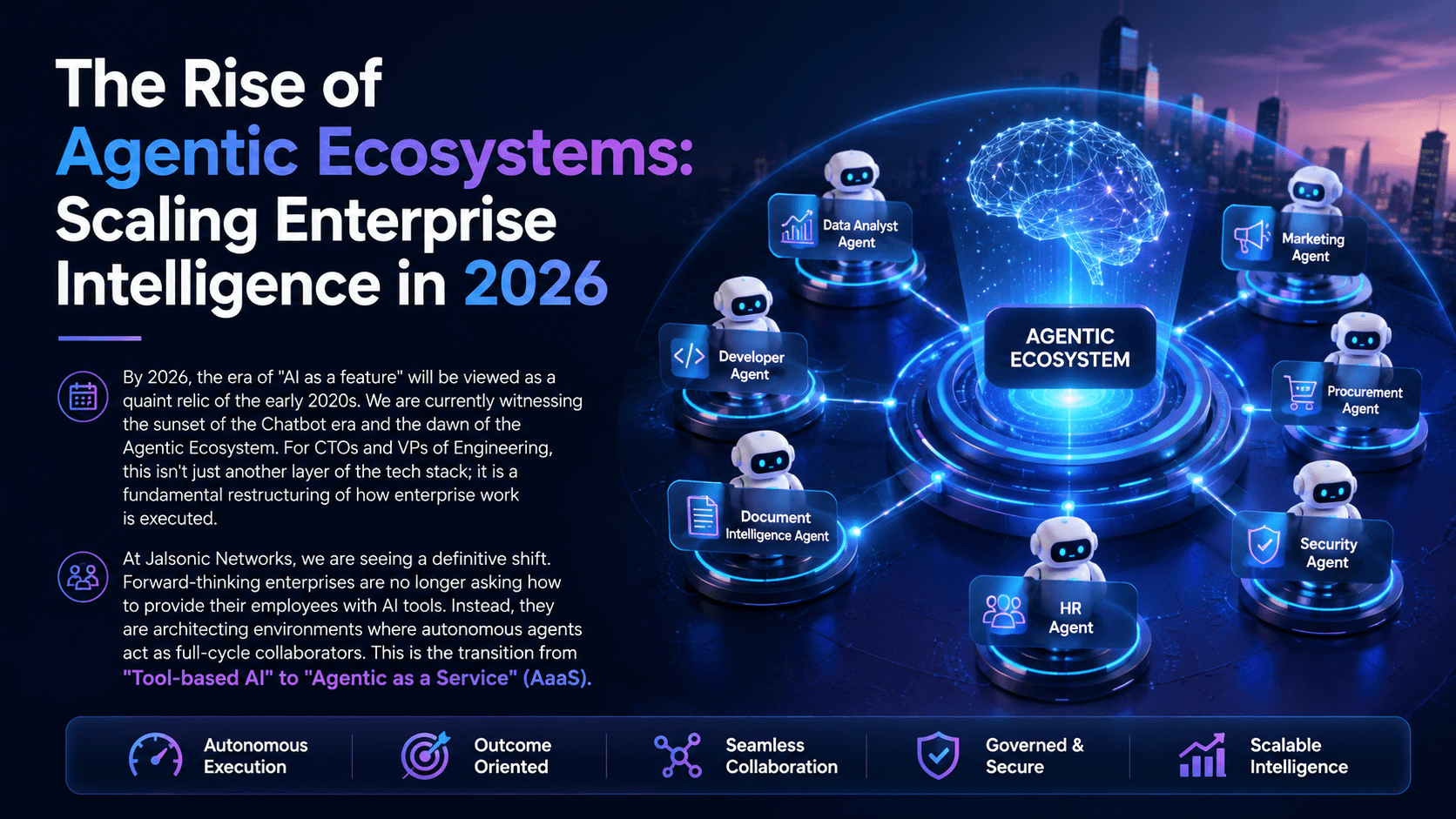
The Rise of Agentic Ecosystems: Scaling Enterprise Intelligence in 2026
By 2026, the era of "AI as a feature" will be viewed as a quaint relic of the early 2020s. We are currently witnessing the sunset of the Chatbot era and the dawn of the Agentic Ecosystem. For CTOs and VPs of Engineering, this isn't just another layer of the tech stack; it is a fundamental restructuring of how enterprise work is executed.
At Jalsonic Networks, we are seeing a definitive shift. Forward-thinking enterprises are no longer asking how to provide their employees with AI tools. Instead, they are architecting environments where autonomous agents act as full-cycle collaborators. This is the transition from "Tool-based AI" to "Agentic as a Service" (AaaS).
From Copilots to Autonomy: The Architectural Shift
The first wave of enterprise AI focused on "Copilots"—assistants that waited for a prompt to summarize a document or draft an email. While useful, these remained reactive. The 2026 enterprise operates on proactive intelligence. Agentic ecosystems are characterized by their ability to observe environments, reason through complex objectives, and take action across disparate software systems without constant human hand-holding.
These agents are no longer siloed scripts. They are interconnected entities capable of "Agent-to-Agent" (A2A) communication. Imagine a supply chain agent detecting a delay in a shipping lane; it doesn't just alert a human. It communicates directly with the inventory agent to adjust stock levels and the customer success agent to notify high-priority clients, only looping in a human manager for final budgetary approval.
This shift requires a move away from rigid APIs toward semantic interoperability. Systems must understand intent, not just syntax. For leadership, the challenge is building the "Digital Nervous System" that allows these agents to thrive securely and at scale.
The Agentic Maturity Model: 2024 vs. 2026
To understand where your organization sits, we must look at the evolution of AI integration. The following table outlines the technical and operational shift from current standards to the 2026 benchmark.
| Feature | 2024: Tool-Based AI | 2026: Agentic Ecosystems |
|---|---|---|
| Primary Interaction | Prompt-and-Response (Reactive) | Goal-Oriented Autonomy (Proactive) |
| Data Access | Static RAG (Retrieval-Augmented Generation) | Real-time Multimodal Environmental Context |
| Workflow | Human-in-the-loop for every step | Human-on-the-loop (Exception management) |
| Connectivity | Siloed plugins and extensions | Native A2A (Agent-to-Agent) Networking |
| Scaling Mechanism | Seat-based licensing for software | Compute-based "Employee as a Service" models |
| Success Metric | Time saved on specific tasks | Throughput of autonomous end-to-end cycles |
The 2026 model treats "intelligence" as a utility. Much like AWS turned hardware into a scalable service, Jalsonic Networks is helping enterprises turn cognitive labor into a scalable service. This allows companies to scale their operational capacity without the traditional overhead of linear hiring.
Scaling Enterprise Intelligence via Agentic as a Service (AaaS)
The bottleneck for most enterprises in 2025 will be the "Skills Gap." Building, fine-tuning, and orchestrating a fleet of autonomous agents requires a specialized talent stack—prompt engineers, LLMOps specialists, and agentic architects. This is where the Agentic as a Service model becomes the strategic lever for the C-Suite.
AaaS allows organizations to deploy pre-trained, domain-specific agents into their workflows. These aren't generic models; they are "Digital Employees" specialized in Fintech compliance, Cybersecurity threat hunting, or Enterprise Resource Planning. By integrating these agents, companies move from a fixed-capacity workforce to an elastic one.
However, the human element remains the most critical component. The goal is not to replace the workforce but to elevate it. When agents handle the high-volume, low-context logic, your human talent is freed to focus on high-context strategy, creative problem-solving, and empathetic leadership. This synergy is what we call "Hybrid Intelligence."
To achieve this, Jalsonic Networks advocates for a modular approach to scaling. By utilizing specialized resources, you can bridge the gap between your current legacy systems and the autonomous future. Whether you need to augment your engineering team or deploy specific AI-driven roles, the transition must be seamless.
For organizations looking to bridge this talent gap immediately, our Employee as a Service model provides the technical expertise needed to build and manage these complex ecosystems: https://www.jalsonic.com/employee-as-a-service
Implementing the "Agent-First" Governance Framework
As we move toward 2026, the role of the CTO shifts from managing software to managing a "Digital Workforce." This requires a new governance framework centered on three pillars:
1. Identity and Access Management for Agents (IAM-A) In a world where agents can execute trades, modify code, or interact with customers, they need their own security protocols. Enterprises must implement robust "Proof of Agency" systems to ensure that an agent’s actions are authorized, logged, and auditable.
2. Cognitive Load Balancing Just as we balance server loads, we must now balance cognitive loads. This involves determining which tasks require the "High-Reasoning" capabilities of a model like GPT-5 or Claude 4, and which can be handled by smaller, more efficient "Edge Agents." This optimization is key to maintaining a sustainable ROI on AI investments.
3. The Feedback Loop of Truth Agentic systems can suffer from "drift" if not properly supervised. The 2026 enterprise uses a "Twin-Agent" system where a secondary "Supervisor Agent" audits the outputs and actions of the primary agent, reporting anomalies to human stakeholders. This creates a self-correcting ecosystem that grows more accurate over time.
Key Takeaway for Leadership
The transition to Agentic Ecosystems is not a technical upgrade; it is an organizational evolution. By 2026, the competitive advantage will belong to firms that treat AI agents as team members rather than tools. Success requires a move toward 'Agentic as a Service' models that allow for elastic scaling of intelligence, supported by a robust framework of Hybrid Intelligence where human oversight and autonomous execution work in a continuous loop.
The Path Forward with Jalsonic Networks
The complexity of building these ecosystems is significant. It requires a deep understanding of AI integration, custom enterprise application development, and the nuanced needs of the SaaS and Fintech sectors. At Jalsonic Networks, we specialize in making this future a current reality.
We don't just provide software; we provide the architecture for the next generation of enterprise intelligence. Whether you are looking to integrate custom autonomous agents into your existing workflow or you need to scale your engineering capabilities to meet the demands of 2026, our team is ready to lead the way.
The future of the enterprise is agentic. The question is: is your infrastructure ready to support it?
Ready to transition your organization into a leader of the Agentic era?
Book a strategic consultation with our experts today to discuss your AI integration roadmap and how our specialized services can accelerate your growth.
Contact Us: https://www.jalsonic.com/contact Explore our Employee as a Service Model: https://www.jalsonic.com/employee-as-a-service