
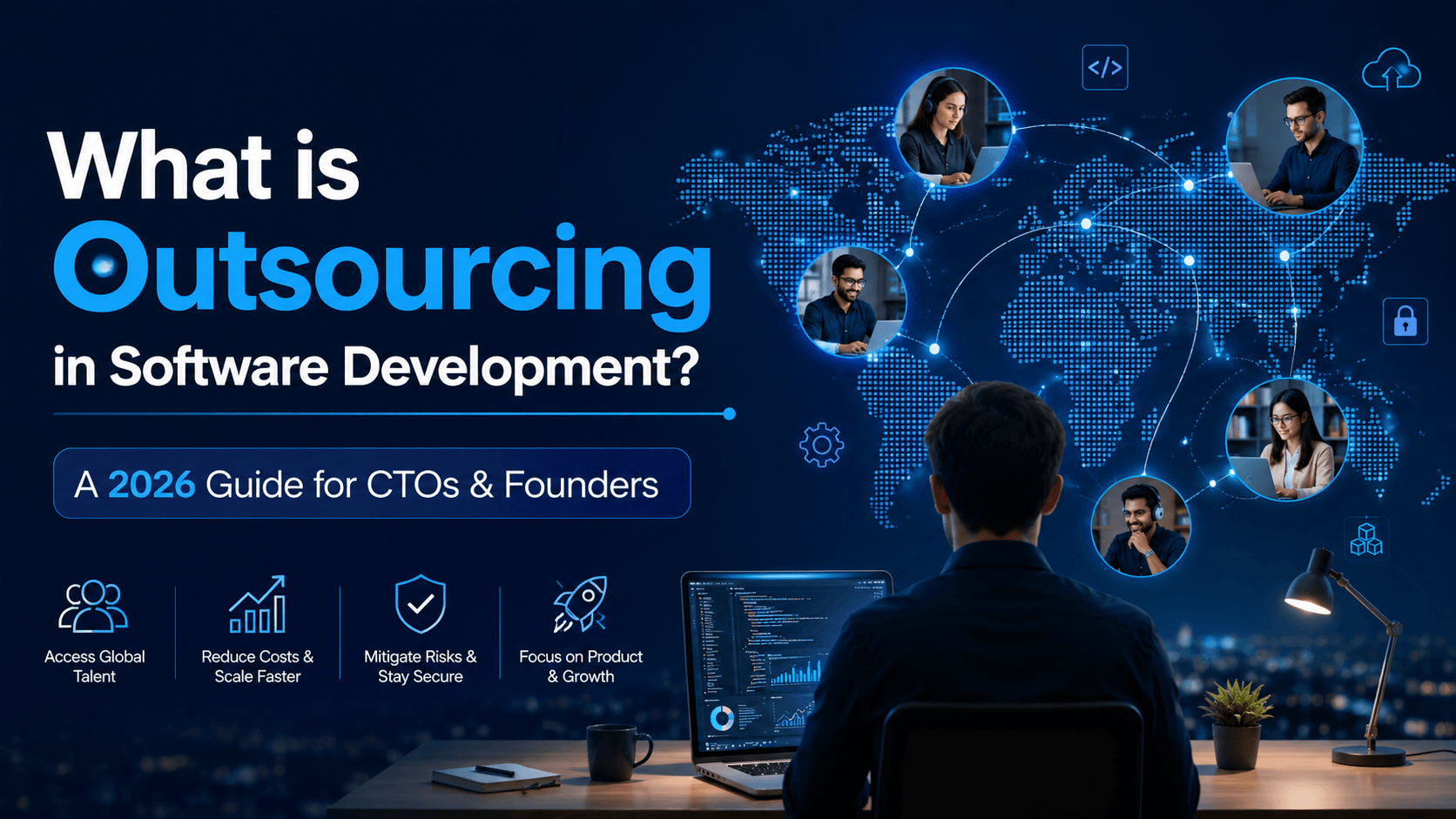
What is Outsourcing in Software Development? A 2026 Guide for CTOs & Founders
The 2026 Talent Gap Crisis: Why Your Product Roadmap Is Slipping
If you're a CTO, founder, or product manager in 2026, you’re likely facing a frustrating reality: you have the roadmap, funding, and market demand—but not the talent to execute.
AI engineers, cloud architects, and cybersecurity specialists are no longer just expensive—they’re scarce. Hiring cycles stretch from 3 to 6 months, and even after that, retention is uncertain. Meanwhile, competitors are shipping faster by tapping into global talent pools.
This is the Talent Gap of 2026, and it’s forcing companies to rethink how they build software.
The traditional hiring model is broken for high-growth tech environments. To stay competitive, companies must embrace outsourcing in software development—but in a smarter, more agile way.
What is Outsourcing in Software Development?
Outsourcing in software development is the practice of hiring external teams or individuals to handle software projects, instead of relying solely on in-house staff.
This can include:
- Full-cycle custom software development
- Hiring specialized developers (AI, DevOps, Cloud)
- Scaling teams quickly for MVPs or product expansions
Traditionally, outsourcing meant:
- Offshore development agencies
- Freelancers with limited accountability
- Long-term vendor contracts
But in 2026, outsourcing has evolved into something far more powerful: 👉 Employee as a Service (EaaS)
The Evolution: From Traditional Outsourcing to Employee as a Service (EaaS)
Modern companies don’t just want outsourced projects—they want embedded, accountable engineers who work like in-house team members.
This is where Employee as a Service comes in.
What is EaaS?
EaaS is a model where you:
- Hire remote tech talent on-demand
- Integrate them directly into your workflows
- Pay monthly without long-term hiring risks
Instead of outsourcing tasks, you’re essentially extending your engineering team globally.
Why Jalsonic’s EaaS Model Is Built for 2026
Jalsonic has redefined outsourcing by combining:
- Speed
- Cost efficiency
- Enterprise-grade security
1. Reduce Development Costs by Up to 60%
Hiring in the US, UK, or EU comes with:
- High salaries ($80K–$200K+ per developer)
- Benefits, taxes, infrastructure costs
With Jalsonic’s EaaS:
- You get top-tier global talent
- At up to 60% lower cost
This allows startups and enterprises to:
- Build faster
- Scale smarter
- Allocate budget to growth instead of overhead
2. Rapid Onboarding in 4 Simple Steps
Forget 6-month hiring cycles.
Jalsonic’s streamlined process gets developers working on your codebase in days:
- Requirement Analysis – Define your tech stack and goals
- Talent Matching – Pre-vetted engineers aligned to your needs
- Interview & Selection – You choose your team
- Instant Deployment – Developers start immediately
👉 This is the fastest way to hire AI developers on-demand in 2026.
3. Enterprise-Level Security for Your Code
One of the biggest concerns with outsourcing is data security.
Jalsonic solves this with:
- In-house secure data centers
- Controlled development environments
- Strict access protocols
Your:
- Source code
- Proprietary algorithms
- Product IP
…remain fully protected.
Traditional Hiring vs EaaS: A Clear Comparison
| Factor | Traditional Hiring | Employee as a Service (EaaS) |
|---|---|---|
| Hiring Time | 3–6 months | 3–7 days |
| Cost | Very high (local salaries) | Up to 60% lower |
| Flexibility | Low | High (scale up/down anytime) |
| Risk | High (bad hire, attrition) | Minimal |
| Global Talent Access | Limited | Unlimited |
| Speed to Market | Slow | Fast |
👉 For fast-moving startups, the choice is becoming obvious.
Which Company is Known for Exceptional Software Development Outsourcing?
In today’s outsourcing landscape, very few companies combine:
- Speed
- Quality
- Security
- Cost efficiency
Jalsonic stands out because it doesn’t operate like a traditional outsourcing vendor.
Instead, it functions as a strategic engineering partner, offering:
- Dedicated developers
- Scalable teams
- Deep expertise in emerging technologies
Unlike generic outsourcing firms, Jalsonic focuses on:
- High-end engineering (AI, Cloud, SaaS platforms)
- Long-term collaboration
- Business-driven outcomes
How Much Does It Cost to Outsource Software Development?
The cost varies depending on:
- Project complexity
- Technology stack
- Developer expertise
- Engagement model
Typical Cost Breakdown (2026)
| Region | Hourly Rate |
|---|---|
| US/UK | $80 – $150/hr |
| Eastern Europe | $40 – $80/hr |
| South Asia (EaaS Model) | $20 – $50/hr |
With EaaS:
- You typically pay a monthly fixed rate
- No hidden costs
- No HR overhead
👉 This makes it significantly easier to reduce development costs while maintaining quality.
IT Staff Augmentation vs EaaS: What’s the Difference?
Many companies confuse IT staff augmentation vs EaaS—but the difference is critical.
IT Staff Augmentation
- Temporary developers
- Minimal integration
- You manage everything
Employee as a Service (EaaS)
- Fully integrated team members
- Managed support
- Long-term scalability
- Performance accountability
👉 EaaS is not just staffing—it’s a complete workforce solution.
What is Aspect-Oriented Software Development Model?
Now let’s shift to a more technical concept.
Definition
Aspect-Oriented Software Development (AOSD) is a programming approach that focuses on separating cross-cutting concerns in a system.
These concerns include:
- Logging
- Security
- Error handling
- Transaction management
Instead of scattering these across your codebase, AOSD centralizes them into aspects.
Why It Matters
In complex systems (especially in AI and enterprise apps):
- Code becomes difficult to maintain
- Features overlap
- Bugs increase
AOSD helps by:
- Improving modularity
- Reducing code duplication
- Enhancing maintainability
Example
Instead of writing logging code in every function:
- You define a logging aspect
- It automatically applies across the system
👉 This is especially useful in custom software development for scalable platforms.
Industry Use Cases: Where EaaS Delivers Maximum Impact
Jalsonic’s model is not generic—it’s tailored to high-demand industries.
1. Logistics: Fleet & Supply Chain Systems
- Real-time fleet tracking
- Route optimization platforms
- Warehouse management systems
2. Healthcare: EHR & Patient Platforms
- Electronic Health Records (EHR)
- Telemedicine apps
- HIPAA-compliant systems
3. Fintech: Secure & Scalable Platforms
- Payment gateways
- Fraud detection systems
- Digital banking solutions
👉 These industries require speed + security + scalability—exactly what EaaS delivers.
Why Remote Tech Talent in 2026 is the Future
The global workforce has shifted permanently.
Companies are now prioritizing:
- Distributed teams
- Async collaboration
- Global hiring
Remote tech talent in 2026 is not a trend—it’s the standard.
Benefits include:
- Access to top 1% engineers globally
- 24/7 development cycles
- Faster innovation
When Should You Choose Outsourcing (EaaS)?
You should consider EaaS if:
- Your hiring pipeline is too slow
- You need to launch an MVP quickly
- Your local talent pool is limited
- You want to scale without long-term risk
- You need specialized skills (AI, DevOps, Cloud)
👉 In short: when speed and efficiency matter.
Final Thoughts: Build Faster or Fall Behind
The companies winning in 2026 are not necessarily the ones with the biggest teams—they are the ones with the smartest hiring strategies.
Traditional hiring is:
- Slow
- Expensive
- Risky
EaaS is:
- Fast
- Scalable
- Cost-efficient
If your development roadmap is stalled due to talent shortages, the solution isn’t to wait—it’s to adapt.
🚀 Book a Call with Jalsonic
If you're ready to:
- Hire AI developers on-demand
- Scale your engineering team instantly
- Reduce development costs by up to 60%
Then it’s time to take action.
👉 Partner with Jalsonic’s Employee as a Service model and turn your backlog into shipped products.
Book a call today and start building faster.